Synthetic speech detection
Compared anti-spoofing models at telling real Latin American Spanish speech from synthetic speech, and measured how accent and noise affect detection.
The problem
Sintetica builds text-to-speech voices in Rioplatense Spanish. The same technology makes voice deepfakes easier, so the team wanted a detector for synthetic speech in Spanish, where most anti-spoofing work is in English. The project was part of a colleague’s undergraduate thesis, and I joined it during my internship.
What I did
- Compared existing anti-spoofing models and their options on Spanish data, starting from models built for the English ASVspoof benchmark.
- Built the dataset tooling: splits, duplicate detection, protocol checks and test sets segmented by signal-to-noise ratio.
- Ran the statistics: SNR and duration distributions, Kolmogorov-Smirnov and Mann-Whitney tests, Kruskal-Wallis across accents with effect sizes, and SNR-score correlations.
- Shipped a Gradio app in Docker that scores a batch of files and exports the results.
Results
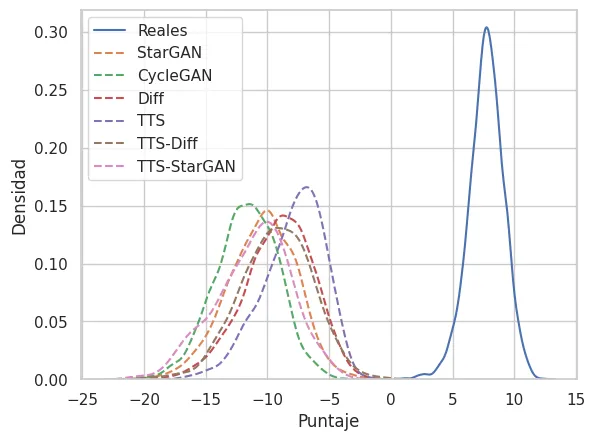
On HABLA, a Latin American Spanish dataset, the detector reached an equal error rate of 0.74%, between 0.50% and 1.03% across accents. On Sintetica’s own voices it was 8.94%, and rose to 23.46% once noise lowered the SNR: robust to accent, sensitive to noise.